
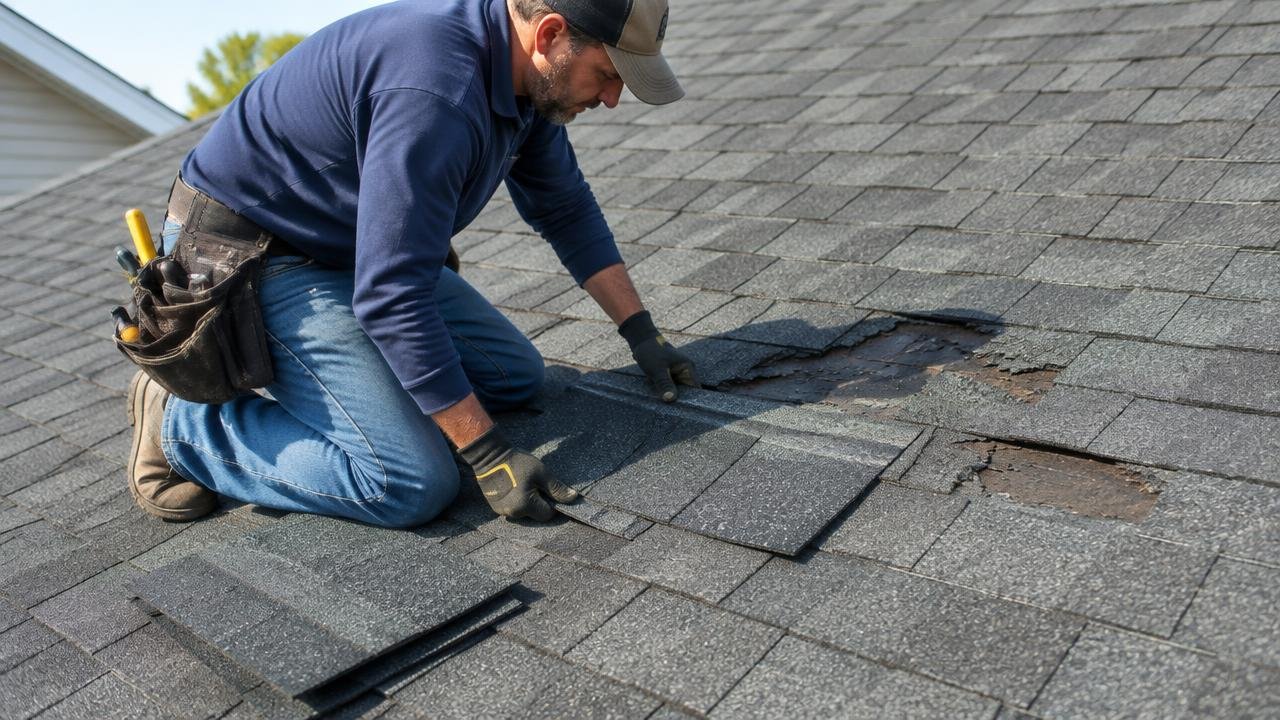
Discovering damaged shingles, an active ceiling leak, or storm debris on your property can quickly induce panic. As a homeowner or commercial property manager, your immediate concern is almost always financial: Can this problem be fixed with a quick patch, or am I looking at the substantial expense of a complete roof tear-off?
Deciding whether to repair or replace your roof is rarely a simple black-and-white choice. Central Indiana weather brings intense summer heat, sudden severe hail, high winds, and winter freeze-thaw cycles that push roofing materials to their limits. A minor leak could simply be an isolated flashing issue, or it could be an early warning sign that your entire roofing system has reached the end of its functional lifespan.
Making the wrong choice can be costly. Pouring thousands of dollars into recurring repairs on an aging roof is a waste of money, while tearing off a roof that still has a decade of healthy service life is an unnecessary expenditure. This guide outlines the key variables—including roof age, extent of damage, structural decking condition, and financial thresholds—to help you make the best decision for your property.
The Age of Your Roofing System
Age is frequently the single most important factor in the repair-versus-replace equation. Even the highest-quality asphalt shingles naturally degrade over time as sunlight evaporates their volatile petroleum oils, leaving them brittle and susceptible to wind lift and moisture intrusion.
Understanding how long a roof lasts in Indiana provides valuable context. Standard 3-tab shingles generally last 15 to 20 years, whereas architectural dimensional shingles often endure 20 to 25 years under normal conditions. If your current roof is under 10 years old and has experienced localized mechanical damage, a professional repair is almost always the sensible and economical path.
Conversely, if your roof is 18 to 22 years old and begins developing leaks, investing in piecemeal fixes is usually a losing strategy. As shingles become brittle with age, repairing one area often damages adjacent shingles, creating a continuous cycle of service calls. In older roofs, money spent on repairs is often better redirected toward a planned replacement.
Evaluating the Scope: Localized vs. Widespread Damage
The physical distribution of your roof damage plays a pivotal role in deciding your next steps. Roofing issues generally fall into two categories: isolated component failures and systemic degradation across entire slopes.
Localized issues are prime candidates for targeted roof repair. If a fallen tree limb punctures a small section of decking, or a high-wind gust rips away a half-dozen shingles from a single ridge cap, replacing those specific shingles and patching the underlayment restores full watertight protection without disturbing the rest of the roof.
Similarly, many persistent leaks are not caused by failed shingles at all, but by compromised metal around chimneys, skylights, or wall junctions. Professional flashing repair and precision leak detection can easily solve these problems at a fraction of the cost of a full replacement. However, when you observe widespread granule shedding, curled shingle tabs across multiple slopes, or widespread soft spots in the roof deck, the system as a whole has failed.
- Repairs work best for: isolated wind blow-offs under 10-15 shingles, flashing gaps around chimneys or vents, minor localized pipe boot failures, and localized punctures from fallen branches.
- Replacements are necessary for: widespread shingle curling or cupping, massive granule loss exposing fiberglass matting, chronic leaks appearing in multiple disconnected rooms, and visible structural sagging.
The 30% Rule and Financial Thresholds
Roofing professionals often rely on a financial rule of thumb when advising clients: the 30% rule. If the estimated cost of needed repairs exceeds 30% to 40% of the cost of a total roof replacement, or if more than 30% of the roof's overall square footage requires work, replacing the entire roof is usually the more financially sound decision.
Consider the long-term economics. Spending $2,500 to patch an aging roof that will need a $10,000 replacement in two years yields a poor return on investment. Furthermore, multiple localized repairs create a patchwork quilt of mismatched shingle dye lots, which can significantly detract from your home's curb appeal and appraisal value.
Building codes also enforce certain limitations. In many municipalities across Indiana, local residential building codes restrict contractors from adding a second layer of shingles over an existing roof or require complete replacement if structural damage exceeds specified area percentages. Always consult an experienced contractor familiar with local building standards.
Storm Damage and Insurance Considerations
In Central Indiana, weather events frequently take the repair-or-replace decision out of the homeowner's hands. Severe spring hail storms and derecho straight-line winds can severely compromise a roof in just a few minutes, causing impact fractures that aren't always visible from the ground.
If your roof has experienced sudden, catastrophic damage from hail or severe wind, your homeowners insurance policy may cover the restoration costs. Insurance carriers evaluate whether the damage can be reasonably repaired without compromising the roof's integrity or aesthetic value.
When storm damage is widespread across multiple slopes, insurance adjusters typically approve a full replacement minus your deductible. If you suspect your home has been hit by a recent severe storm, scheduling a professional inspection for storm damage before filing an insurance claim gives you the documented evidence and photographic proof needed to navigate the claims process smoothly.
Aesthetics, Material Matching, and Home Resale
Even when a roof repair is technically feasible from a structural standpoint, aesthetics must be taken into account. Asphalt shingles are manufactured in batches with specific dye lots, and prolonged exposure to ultraviolet radiation fades their color significantly over time. Finding an exact match for 10-year-old shingles is virtually impossible.
If damage occurs on a prominent, street-facing slope, a patch with newly manufactured shingles will stand out noticeably. For homeowners preparing to sell their property within the next 24 to 36 months, visible patchwork can become an immediate red flag for prospective buyers and home inspectors.
Upgrading to modern asphalt shingle roofing provides architectural dimensional shingles that enhance curb appeal, feature Class 3 or Class 4 impact resistance, and carry wind resistance ratings up to 130 miles per hour. A clean, brand-new roof routinely delivers one of the highest returns on investment among major home renovation projects.
How to Make Your Decision: Repair vs. Replace Checklist
To summarize your decision, assess your roof against these core considerations. Choose repair when your roof is under 12 years old, damage is isolated to a single manageable area, flashing around penetrations is the primary culprit, and your attic insulation and wood decking remain completely dry.
Opt for a complete replacement when your roof is nearing or past 20 years old, shingles show widespread curling or cracking, repair estimates climb above a third of replacement costs, or multiple active leaks threaten your interior drywall and electrical systems.
The safest way to protect your home and your budget is to schedule an objective, on-site assessment. Central Indy Roofing provides residential and commercial property owners with clear documentation, honest evaluations, and customized solutions tailored to your property. Contact us today to schedule your free roof inspection and get a free, detailed estimate by calling 317-836-2455.
Frequently Asked Questions
- Can I just repair a leaking roof instead of replacing the whole thing?
- Yes, absolutely—provided the leak is caused by an isolated issue such as cracked pipe boot flashing, a damaged valley, or a few dislodged shingles. If the underlying wood decking is sound and the surrounding shingles are in good, pliable condition, a targeted repair can resolve the leak and extend your roof's service life for years.
- Will homeowners insurance cover a roof replacement if the roof is already old?
- Homeowners insurance covers sudden, accidental damage from events like hail, falling trees, and windstorms, regardless of roof age, but policies do not cover normal wear and tear or maintenance neglect. Depending on your policy type (Replacement Cost Value vs. Actual Cash Value), depreciation may be factored in for older roofs, meaning your payout may be adjusted based on the roof's age.
- Is it possible to replace only one slope or half of a roof?
- While replacing a single slope is technically possible, most reputable contractors advise against it unless there is a distinct architectural separation. Shingles from different manufacturing runs will not match in color, ridge caps must be tied into both planes, and the older unreplaced side will still require complete tear-off in the near future, resulting in higher overall labor costs over time.
- How can I tell if the plywood roof decking underneath is rotted?
- Signs of rotted decking include spongy, springy areas when walking on the roof, visible dips or sagging planes between rafters, water stains or dark mold spots visible on the underside of the sheathing from inside your attic, and rusted nails backing out through shingles.