When managing an industrial facility, retail center, office park, or multi-family property, the roof represents one of your most substantial capital investments. Commercial flat and low-slope roofing systems are engineered to withstand continuous environmental stress while protecting tenants, sensitive electronic equipment, inventory, and building structures. For facility executives and property owners across Central Indiana, a common and critical question is: exactly how long does a flat roof last on a commercial building before requiring major restoration or a full replacement?
On average, a commercial flat roof lasts between 15 and 35 years. However, this lifespan varies widely based on the roofing material selected, the skill of the original installers, local environmental stressors, drainage design, and how diligently preventive maintenance is conducted. Because commercial buildings in the Indianapolis area experience intense seasonal shifts—from freezing winter freezes and heavy snow loads to intense summer humidity and torrential convective storms—local flat roofs require informed oversight. Understanding what dictates roof longevity enables you to plan capital expenditure cycles proactively and avoid catastrophic, unexpected disruptions to your enterprise.
Average Lifespan by Commercial Flat Roofing Material
The single most influential factor in determining how long your commercial roof will survive is the chemical composition and engineering of the membrane itself. Modern low-slope roofs rely on a handful of proven material formulations, each presenting distinct physical characteristics, maintenance demands, and realistic service horizons.
When evaluating a potential roof installation or reviewing the current membrane on your facility, comparing TPO vs. EPDM roofing alongside alternatives like PVC and multi-ply systems provides a realistic baseline for long-term planning.
- EPDM (Ethylene Propylene Diene Monomer): Typically lasts 22 to 32 years. This synthetic vulcanized rubber membrane offers remarkable flexibility, thermal expansion accommodation, and resistance to ultraviolet radiation, making it a reliable workhorse for Midwest industrial and commercial structures.
- TPO (Thermoplastic Polyolefin): Typically lasts 18 to 28 years. TPO has become an industry standard due to its heat-welded seams and brilliant white reflective surface, which helps decrease summer cooling costs while resisting mold, punctures, and common chemical exposure.
- PVC (Polyvinyl Chloride): Typically lasts 20 to 30 years. Highly durable and impervious to animal fats, greases, and heavy chemical exhausts, PVC is frequently chosen for commercial kitchens, manufacturing facilities, and food-processing hubs.
- Built-Up Roofing (BUR): Typically lasts 20 to 30 years. Composed of alternating layers of bitumen (asphalt or coal tar) and reinforcing fabrics topped with gravel, traditional BUR provides redundant protection and superior resistance to heavy rooftop foot traffic.
- Modified Bitumen: Typically lasts 15 to 22 years. An evolution of traditional BUR, this asphalt-based system incorporates rubber or plastic modifiers applied in multiple factory-manufactured rolls, providing dependable strength and impact resistance.
How Indiana Weather Impacts Flat Roof Longevity
Even the most premium commercial roofing material will degrade prematurely if it is not engineered to withstand the regional climate. In Central Indiana, flat roofing membranes must navigate dramatic year-round meteorological stress. Summer surface temperatures on non-reflective flat roofs can easily surpass 150 degrees Fahrenheit during July heatwaves, accelerating ultraviolet degradation and drying out protective plasticizers.
As the seasons shift, Central Indiana winters introduce continuous freeze-thaw cycles. When moisture infiltrates small membrane hairline cracks or unbonded perimeter laps, the water expands by roughly nine percent as it freezes. This cyclical hydraulic pressure tears seams apart, separates flashings from parapet walls, and breaks down adhesive bonds. Combined with heavy winter snow packs that compress insulation and expose low-slope roofs to localized ponding as the snow slowly melts, regional weather conditions require proactive structural oversight.
Drainage Design and the Danger of Ponding Water
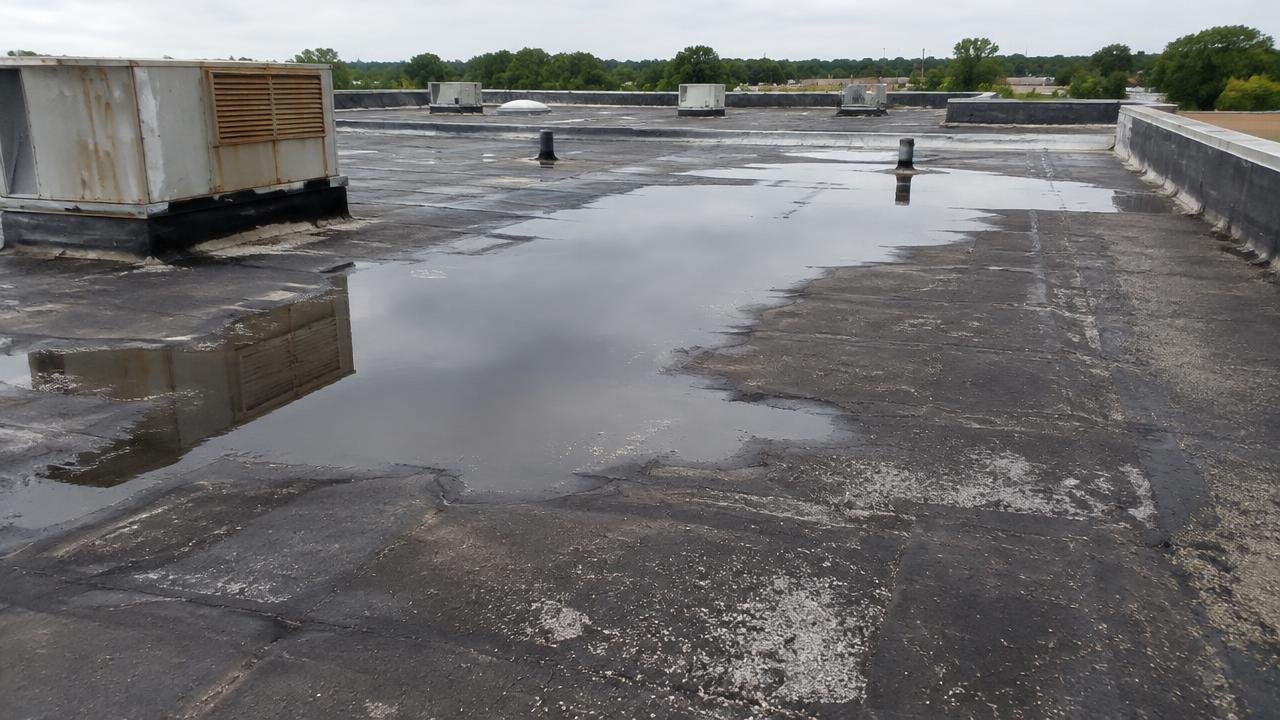
A common industry axiom holds that no roof is entirely flat. Commercial flat roofs are formally categorized as low-slope systems, engineered with a subtle pitch—generally a minimum of one-quarter inch per foot—designed to direct precipitation toward interior drains, scuppers, or external commercial gutters. When a roof exhibits structural settling, compressed underlayment board, or blocked drainage routes, water begins to collect in low areas.
Ponding water is defined within commercial roofing standards as liquid that remains standing on a membrane surface for longer than 48 hours following precipitation. Standing water is arguably the foremost catalyst for early flat roof failure. The weight of pooled water strains roof decking, magnifies UV exposure by acting as a magnifying lens for sunlight, promotes aggressive algae and bacterial growth, and breaks down membrane adhesives. On expansive properties like distribution centers and warehouse roofing facilities, unchecked drainage failure can lead to catastrophic membrane saturation and costly structural damage.
The Critical Role of Scheduled Preventive Maintenance
The difference between a commercial roof reaching its full 30-year design life or failing prematurely at year twelve almost always comes down to the frequency of routine maintenance. Roofing manufacturers specify that warranties remain valid only when verifiable, professional inspections occur at scheduled intervals.
Comprehensive management of commercial property roofing demands bi-annual professional inspections—ideally scheduled in late spring following the thaw and in late autumn prior to winter storms. These inspections systematically examine perimeter edge metal, pitch pockets, pipe boots, expansion joints, and parapet termination bars where leaks commonly start. Scheduling regular professional roof inspections prevents minor membrane abrasions, often caused by HVAC contractors servicing rooftop chillers or technicians walking across unsheltered membranes, from turning into pervasive interior leaks.
- Clearing rooftop drains, gutters, downspouts, and secondary overflow scuppers of leaves, trash, and silt to prevent backed-up water.
- Checking heat-welded or chemically adhered membrane seams for voids, fishmouths, or stress lifting.
- Examining rooftop HVAC equipment curbs, condensation drain lines, skylight perimeters, and electrical conduit penetrations for cracked sealants.
- Identifying soft spots under the membrane indicating wet polyisocyanurate insulation boards that require immediate extraction before mold colonies develop.
Warning Signs That a Commercial Flat Roof Is Nearing End-of-Life
As commercial systems approach the outer boundaries of their service life, they communicate specific visual and structural warning signals. Facility directors should monitor their buildings for recurring leaks in multiple building quadrants, widespread blistering or tenting along membrane joints, severe alligatoring on asphalt surfaces, or significant membrane shrinkage pulling flashings away from parapets.
When repair calls become frequent, investing additional capital into short-term spot repairs often yields diminishing returns. Reviewing total life-cycle costs and evaluating commercial roof replacement cost allows leadership to determine whether a full system tear-off, an overlay re-cover, or an elastomeric fluid-applied restoration coating offers the best financial return for the commercial property.
Extending Flat Roof Life and Protecting Your Building Asset
Maximizing the return on your commercial roofing investment requires treating the assembly as an active building asset rather than an out-of-sight component. Installing durable walk pads along high-traffic routes to rooftop equipment, enforcing strict sign-in logs for third-party mechanical vendors, and quickly resolving minor membrane cuts will add years of service life to an existing low-slope roof.
Whether you are tracking an aging EPDM membrane, budgeting for a new energy-efficient TPO installation, or dealing with active leaks following a severe storm, our experienced team provides thorough assessments and dependable commercial solutions. Contact Central Indy Roofing at 317-836-2455 today or schedule your comprehensive free roof inspection and customized commercial estimate.
Frequently Asked Questions
- Can applying a roof coating extend the lifespan of an older flat roof?
- Yes. If the underlying insulation is dry and the membrane remains structurally sound and well-adhered, an elastomeric silicone or acrylic fluid-applied roof coating can extend the roof's operational life by 10 to 15 years while restoring UV reflectivity and eliminating minor seam vulnerabilities.
- How can I tell if my flat roof insulation is waterlogged?
- Common indicators of wet insulation include spongy or squishy sections when walking on the membrane, sudden spikes in facility heating and cooling utility bills, indoor odors, or localized interior ceiling staining. Commercial roofing contractors can perform non-destructive infrared moisture scans to pinpoint trapped water accurately.
- How often should commercial flat roofs be inspected?
- Commercial flat roofs should undergo a comprehensive professional inspection at least twice per year—once during spring and once during late autumn. In addition, prompt inspections should be performed immediately following severe weather events involving high winds, microbursts, or hail.
- What is the single most durable flat roofing material for Indiana businesses?
- For buildings prioritizing long-term puncture resistance, flexibility, and extreme weather endurance, 60-mil or 90-mil EPDM rubber and reinforced PVC membranes rank among the most durable choices available for Central Indiana's fluctuating climate.